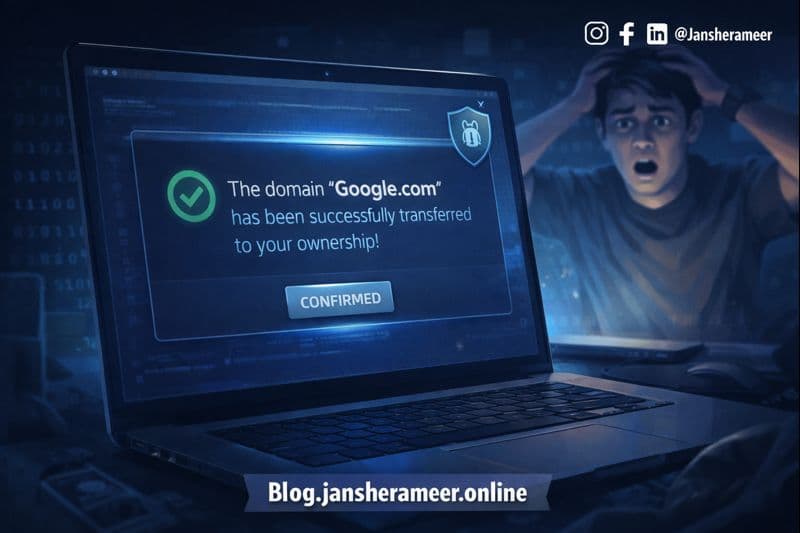
The Day Google.com Was Bought for $12
In the high-stakes world of cyberspace, even the most powerful tech giants are not immune to slip-ups. But few incidents are as unusual — or as fascinating — as the day Google.com, the crown jewel of the internet, was owned by a student for just one minute.
Yes, you read that right. Back in October 2015, a Babson College student named Sanmay Ved made international headlines by purchasing one of the most valuable domain names in the world for just $12.
This is not the story of a hacker. Nor is it a tale of some secret exploit. Instead, it sits at the intersection of curiosity, luck, and a rare digital oversight.
Ved, a former Google employee, was casually browsing Google Domains — Google’s own domain registration service — when something unbelievable appeared on his screen: Google.com was listed as available.
Buying the Internet’s Most Valuable Domain
At first, Ved assumed it was a glitch. After all, Google.com is the most visited website on the planet and worth billions in brand value alone.
But curiosity won. He attempted to purchase the domain — and to his absolute shock, the transaction went through.
For one surreal minute, Sanmay Ved was the legal owner of Google.com.
The 60 Seconds That Changed Everything
The ownership didn’t last long — roughly 60 seconds. Ved soon received an email informing him that the domain registration had been canceled.
Google had identified the mistake and immediately reclaimed the domain. Because the transaction occurred inside Google’s own registrar system, the reversal was swift and seamless.
Despite the brief window, Ved temporarily gained access to parts of Google’s backend, including Google Webmaster Tools. Screenshots later shared showed access to domain settings and traffic data.
Importantly, he did not misuse this access. Instead, he responsibly reported the issue.
Google’s Response and the $12,012 Reward
Google is well known for supporting ethical hackers through its Vulnerability Rewards Program (VRP). In recognition of Ved’s responsible disclosure, Google offered him a reward of $6,006.13 — a playful number that spells “Google” on a calculator.
When Ved announced that he planned to donate the money to charity, Google doubled the reward to $12,012.26.
The donation went to The Art of Living India, a nonprofit organization supporting education for underprivileged children.
How Did This Even Happen?
To this day, Google has never publicly explained how Google.com became available. Was it a system bug? A clerical oversight? A domain renewal error?
Whatever the cause, the incident served as a powerful reminder: no digital system is flawless. Even infrastructure supporting billions of users can fail — briefly.
This wasn’t unprecedented either. In 2003, Microsoft forgot to renew Hotmail.co.uk, leading to a much more complicated recovery process. Google’s advantage was simple — they controlled the registrar.
Why This Story Still Matters
This one-minute incident has become a case study in cybersecurity, often discussed at conferences and universities.
Had Ved been malicious, the consequences could have been severe: phishing attacks, malware distribution, or mass data manipulation.
Instead, his ethical actions reinforced the importance of responsible disclosure and programs that reward it. In 2015 alone, Google paid out over $2 million to security researchers.
Final Thoughts
Sanmay Ved’s story is a rare blend of humor, tension, and digital responsibility. Owning Google.com — even for one minute — is something few can claim.
But beyond the novelty lies a deeper truth: the internet runs not just on code and servers, but on people who choose to act ethically when opportunity strikes.
Sometimes, strengthening the internet starts with curiosity — and the courage to click “Buy” on Google.com for $12.